
When you're planning a big group trip, you want everyone to travel together comfortably and on schedule. That's why so many event organizers choose to rent a charter bus! If you've never rented a bus before, you may not know where to start (our guide to renting a charter bus covers the basics), and the name on the back of the bus can be a bit of a mystery. Don't worry! This complete guide to charter bus manufacturers covers the four brands you'll see most often on North American highways: Motor Coach Industries (MCI), Van Hool, Prevost, and TEMSA.
Each manufacturer is known for its own features and style of bus. Keep reading to learn the history of each company, the models they build today, their electric options, and the specs that matter for your trip, like seats, luggage space, and fuel tank capacity.
Charter Bus Manufacturers at a Glance
Short on time? Here's a quick look at who builds what.
| Manufacturer | First Bus or Founding | Where It Started | Parent Company (2026) | Current Models in North America |
|---|---|---|---|---|
| Motor Coach Industries (MCI) | 1933 | Winnipeg, Manitoba | NFI Group | J4500, J3500, D45 CRT, D45 CRT LE, D4520 |
| Van Hool (VDL Van Hool) | 1947 | Koningshooikt, Belgium | VDL Groep | CX35, CX45, CX45E, TDX, TDX25E |
| Prevost | 1924 | Sainte-Claire, Quebec | Volvo Group | H3-45, X3-45, X3-45 Commuter |
| TEMSA | 1968 | Adana, Turkey | Sabancı Holding and PPF Group | TS30, TS35, TS45, TS45E |
Charter Bus Manufacturer Timeline
Want the big picture first? Here's how all four manufacturers line up side by side, from the first wooden bus body in 1924 to the ownership changes and electric models of the last few years.
| Year | Manufacturer | Milestone |
|---|---|---|
| 1924 | Prevost | Eugène Prévost builds his first bus body on a REO truck chassis in Sainte-Claire, Quebec |
| 1933 | MCI | Fort Garry Motor Body and Paint Works builds its first bus in Winnipeg, Manitoba |
| 1947 | Van Hool | Bernard Van Hool's company gets started in Koningshooikt, Belgium, with 22 employees |
| 1957 | Van Hool | Signs its agreement with Fiat and starts selling buses under the Van Hool-Fiat name |
| 1957 | Prevost | Industrialist Paul Normand acquires the company and renames it Prevost Car Inc. |
| 1958 | MCI | Becomes the first manufacturer to build a 40-foot bus |
| 1962 | MCI | Enters the U.S. market with its plant in Pembina, North Dakota |
| 1967 | Prevost | Opens its first U.S. dealership in New Jersey |
| 1968 | TEMSA | Founded in Adana, Turkey |
| 1984 | MCI | Builds the first wheelchair-lift-equipped model, six years before the ADA passed |
| 1985 | Prevost | Debuts the H5-60, the first model in its H-Series |
| 1987 | Van Hool | Its North American partnership with ABC Companies begins |
| 1987 | TEMSA | Produces its first bus under a Mitsubishi licence |
| 1993 | MCI | Launches the D-Series with the 45-foot, 55-passenger 102DL3 |
| 1993 | Prevost | Launches the H3-45 |
| 2001 | MCI | Introduces the J4500 |
| 2004 | Prevost | Volvo Bus Corporation becomes its sole owner |
| 2006 | Prevost | Launches the X3-45 |
| 2008 | TEMSA | Makes its debut in the USA |
| 2011 | Van Hool | Debuts its TX range at Busworld and wins the Grand Award Coach |
| 2015 | MCI | Becomes part of New Flyer (MCI is now a subsidiary of NFI Group) |
| 2021 | MCI | Unveils the battery-electric J4500 CHARGE |
| 2023 | Prevost | Introduces the all-new H3-45 |
| 2024 | Van Hool | VDL Groep acquires Van Hool after its bankruptcy |
| 2024 | Prevost | Celebrates its 100th anniversary |
Every milestone comes from the manufacturer's official history or its official North American partner, linked in the sections below.
Motor Coach Industries (MCI)
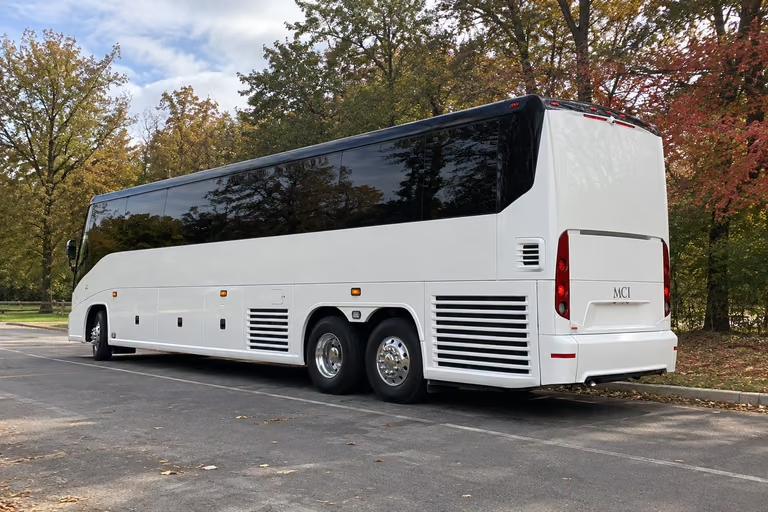
One of the first things that comes to mind when you think about charter buses? Probably that iconic Greyhound logo! But did you know Greyhound and Motor Coach Industries (MCI) share decades of history? According to MCI's company history, Greyhound Lines of Canada acquired a majority interest in MCI in 1948 and bought its remaining shares in 1958. MCI delivered its first bus in 1933, and today it describes itself as the leading motorcoach manufacturer in North America, with nearly 30,000 MCI buses on the road. MCI is now a subsidiary of NFI Group, and it continues to build luxury, workhorse, and battery-electric models to meet transportation needs for communities today, and into the future.
The Complete History of Motor Coach Industries (MCI)
Believe it or not, the company behind some of America's most beloved long-distance charter buses actually began in a small Canadian repair shop. It's a long story, so we'll keep it concise. In 1933, founder Harry Zoltok turned his Winnipeg repair shop into a bus builder called Fort Garry Motor Body and Paint Works, and he sketched his first design, an 11-passenger body on a Packard chassis, right on the factory floor.
In 1937, the company designed its first proprietary chassis and built its first line of buses for Grey Goose Bus Lines in Winnipeg. Two years later, its Model 150 became the first to use exterior stainless steel panels. On January 7, 1941, the company officially changed its name to Motor Coach Industries Limited, but production quickly gave way to the manufacturing needs of World War II. After the war, MCI introduced its first rear-engine bus, the Model 100, in 1946, and in 1958 it became the first manufacturer to build a 40-foot bus.
MCI expanded into the United States in 1962, establishing its plant in Pembina, North Dakota (it officially opened in 1963), and developed the MC-2 through the MC-5A over the rest of the decade. In 1967, MCI delivered the first prototype of the MC-6 "Super Cruiser" with an all-stainless-steel frame, and the MC-9 Crusader II that debuted in 1978 went on to become the nation's all-time best-selling motorcoach, with 6,406 sold between 1978 and 1994.
By 1984, MCI had made a notable commitment to accessible travel by building a wheelchair-lift-equipped model, a full six years before the Americans with Disabilities Act passed in 1990. MCI's dedication to accessibility continued in 2017 with the D45 CRT LE, a commuter model with a low-entry vestibule and seating designed for passengers using mobility devices.
Over the past few decades, MCI has taken pride in its reputation as a forward-thinking, innovative manufacturer. The D-Series arrived in 1993 with the 102DL3, a 45-foot model for 55 passengers. MCI introduced the J4500 in 2001 (it became the industry's best-selling motorcoach by 2004), built its first hybrid diesel-electric commuter model in 2003, became part of New Flyer on December 18, 2015, rolled out the 35-foot J3500 in 2018, and unveiled the battery-electric J4500 CHARGE in 2021.
Motor Coach Industries (MCI) Today
Today, MCI focuses on merging efficiency, luxury, and comfort in its newest models. It has created a network of MCI and affiliated service centers, parts experts, and technical support for the bus companies that run its buses, and its Emergency Roadside Assistance program has been available 24/7 since 2000. MCI says many of its buses have logged a million miles or more, and in 2022, MCI celebrated production of its 10,000th J4500 with longtime customer Cline Tours!
MCI's Bus Fleet
MCI's current lineup falls under the J-Series and the D-Series. The J-Series is the company's most luxurious line, built for tour and charter trips in 35-foot and 45-foot lengths, with interiors designed in collaboration with BMW Group's Designworks. The 45-foot MCI J4500 is what MCI calls North America's best-selling touring motorcoach, with seating for up to 60 passengers, factory-installed 2+1 premium or VIP seating configurations, and USB-A and USB-C port options at each passenger seat. The smaller 35-foot J3500 can seat up to 44 passengers and has a turning radius of under 33 feet to help it maneuver the tight spots. Planning a route with tight drop-off spots? Our charter bus loading and parking guide explains how staging, loading, and parking zones work.
The D-Series was designed as MCI's workhorse line for tour, charter, and commuter service, and it currently includes the D45 CRT, D45 CRT LE, and D4520. Earlier D-Series models like the D4005 and D4505 came out of MCI's 2008 D-Series makeover and are no longer part of its new model lineup.
MCI Bus Specs
Here's a comprehensive list of specifications for MCI's two J-Series models, straight from the MCI J-Series spec sheet:
| Specification | MCI J4500 | MCI J3500 |
|---|---|---|
| Gross Vehicle Weight | 54,000 lbs | 42,000 lbs |
| Height | 141.75 in | 141.75 in |
| Width | 102 in | 102 in |
| Length | 45 ft 7 in | 35 ft 10 in |
| Standard Seats | 56 | 40 |
| Maximum Seats | 60 | 44 |
| Below-Floor Luggage Space (without wheelchair lift) | 445 cu ft | 285 cu ft |
| Parcel Rack Space | 131.2 cu ft | 92.3 cu ft |
| Fuel Tank Capacity (usable) | 200 gal | 164 gal |
Van Hool (VDL Van Hool)
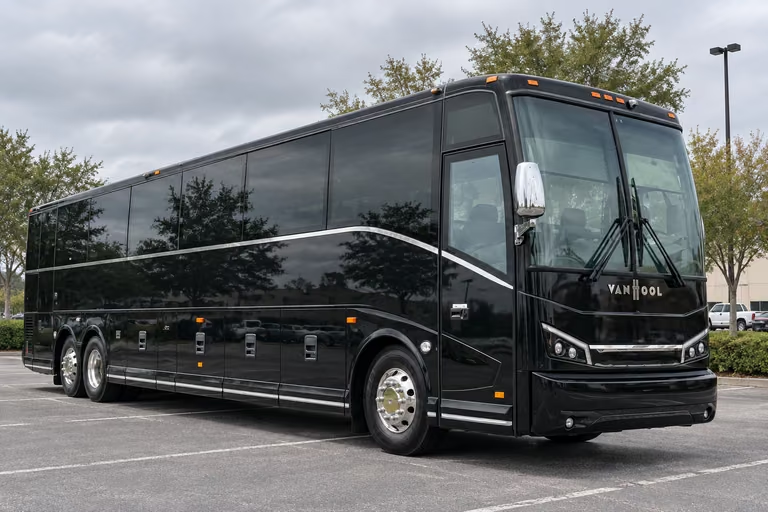
This Belgian bus manufacturer is known for merging comfort and style in its bus designs, and for pushing new technology like hydrogen and battery-electric power. Van Hool started out building bus bodies, and over time it brought fully-manufactured buses to markets around the world. Here's the update you should know before you compare: Van Hool went bankrupt in 2024, and the Dutch company VDL Groep acquired its bus business, so the brand now goes by VDL Van Hool.
The Complete History of Van Hool
Van Hool has an interesting past. What we know as a bus manufacturing giant actually started with construction! According to VDL Van Hool's official history, founder Bernard Van Hool saw a need after World War II for vehicles to transport materials for rebuilding infrastructure, bridges, and roads. He converted an old bus to do the job, and the result was his first bus, "De Trekvogel" (Bird of Passage).
When the company started in 1947, it had 22 employees and 6 family members, and its first bus bodies were often inspired by the large American cars of the day. On February 15, 1957, Van Hool signed a commercial agreement with Fiat for engines, gearboxes, axles, and steering wheels, and it grew from a bus body builder into a full manufacturer of self-supporting buses sold under the Van Hool-Fiat brand name. In 1965, Van Hool built its first buses for Great Britain, and its integral T8 later became the T8 Acron, which Van Hool calls its best-selling model ever.
Van Hool's North American story started when its first 10 integral T8 buses shipped to the USA, followed by an agreement with ABC Bus Companies of Florida for exclusive distribution in the U.S. The American Bus Association reports that the partnership began in 1987 and that more than 12,000 Van Hool buses have traveled North American roads since. In 2011, Van Hool introduced its all-new TX range at Busworld, where it won both the Grand Award Coach and the Environment Award, and in 2013, Van Hool and ABC marked 25 years together by introducing the TX40, TX45, and CX45 for the American market.
With its dedication to new technology, Van Hool also became a leader in alternative power. It announced the CX45E as its first all-electric motorcoach for the U.S. market, and in 2018 it built 30 hydrogen buses for Cologne and 10 for Wuppertal in Germany, which Van Hool called the largest order ever for hydrogen buses in Europe.
Van Hool Today
Van Hool has earned an international reputation, and its airport buses currently operate at dozens of airports around the world. The biggest change came in 2024. After Van Hool went bankrupt, VDL Groep acquired parts of Van Hool, including all of its intellectual property, product names, and the factory in North Macedonia where about 1,350 employees work. As part of that deal, ABC Companies signed a 10-year exclusive distribution agreement to keep delivering Van Hool buses in the United States and Canada. What does that mean for you? The Van Hool name is staying on the road, and new Van Hool models are still sold in North America!
Van Hool's Bus Fleet
Van Hool is best known in North America for its CX series. The 35-foot CX35 and the 45-foot CX45 share a nearly identical design, and the CX45 comes with 56 seats standard and room for up to 60 passengers, with options like seat back tray tables, card tables, and WiFi. The CX45E brings that same CX platform to battery-electric power for bus companies focused on zero emissions. The most impressive bus in the Van Hool lineup, though? The double-decker Van Hool TDX, which can seat 81 passengers! Its sibling, the TDX25E, is what ABC Companies calls the world's first all-electric double-decker, and it carries up to 69 passengers.
The Van Hool models sold new through ABC Companies today are the CX35, CX45, CX45E, TDX, and TDX25E, so earlier TX models you spot on the road are from past model years.
Van Hool Bus Specs
Van Hool is a global manufacturer, which means the specifications for each type of bus can vary by region. For example, VDL Van Hool builds its T series for Europe, while North American passengers ride the CX series. Here are the specifications for Van Hool's 45-foot North American model, from ABC Companies' published Van Hool CX45 specifications:
| Specification | Van Hool CX45 |
|---|---|
| Gross Vehicle Weight Rating | 54,000 lbs |
| Height | 11 ft 6 in |
| Width | 102 in |
| Length | 45 ft |
| Seats | 56 standard (up to 60) |
| Underfloor Luggage Space (without wheelchair lift) | 440.4 cu ft |
| Parcel Rack Space (without wheelchair lift) | 87.5 cu ft |
| Fuel Tank Capacity (usable) | 240 gal |
Prevost
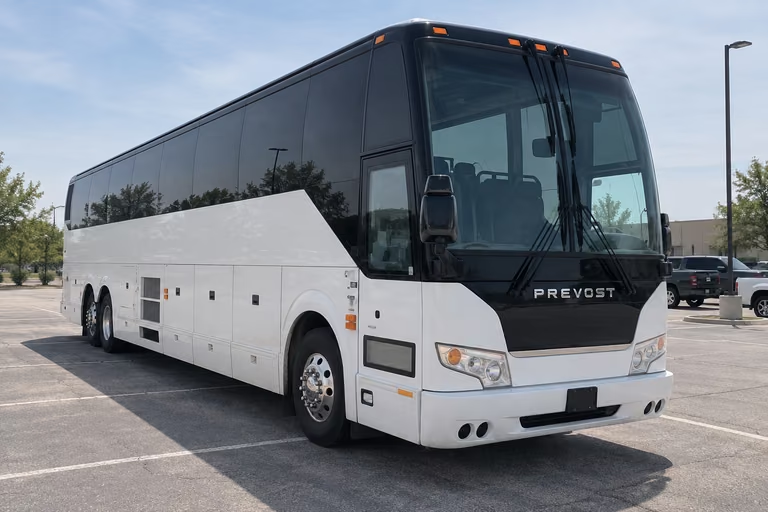
This French-Canadian company has a strong reputation for manufacturing luxury charter buses. Prevost is part of the Volvo Group, and Volvo Bus Corporation has been its sole owner since 2004. Prevost also describes itself as the world leader in bus shells for high-end motorhomes and specialty conversions.
The Complete History of Prevost
Like Van Hool, Prevost had a surprising beginning. What we know today as a charter bus giant began with a small, family-owned business in Sainte-Claire, Quebec, and founder Eugène Prévost actually specialized in making church pews and school furniture!
In 1924, Georges Roy, the owner of a nearby bus line, asked Prévost to build a bus body for a REO truck chassis. According to Prevost's history of its founder, that first body was made of wood with aluminum sheeting, took nearly a year to build, and cost $3,600. It earned such high regard that more bus orders followed.
The Prevost milestones timeline shows the company built its first bus manufacturing facility between 1937 and 1939, introduced the first all-metal body over an all-metal skeleton in 1945, and resumed operations under the name Les Ateliers Prevost in 1948. In 1951, Prevost received 100 orders for highway buses from the Canadian government, and in 1957, industrialist Paul Normand acquired the company and renamed it Prevost Car Inc.
After a few decades of growth, Prevost opened its first American dealership in New Jersey in 1967, quickly followed by a second in Los Angeles. Around the same time, the 1966 Prevost Champion became the first North American model with an integral structure, and it came with three axles, a split level, and air conditioning.
In 1985, Prevost debuted the articulated H5-60, the first of its H-Series, a line of spacious, luxurious models that led to the H3-45 in 1993. Prevost is still known for innovative designs, like the frameless windows it introduced in 1997 for panoramic views on tour and charter trips, the same year it became the first North American bus manufacturer to earn ISO 9001 certification for its manufacturing and design operations. Volvo Bus Corporation and Henlys Group acquired Prevost in 1995, Volvo became the sole owner in 2004, and Prevost celebrated its 100th anniversary in Sainte-Claire in 2024.
Prevost Today
Today, Prevost continues to set the standard in luxury bus manufacturing, and the all-new Prevost H3-45 introduced at the 2023 UMA EXPO shows it. Passengers step up a larger, curved entranceway with 300% brighter lighting, enjoy better views thanks to an all-new window layout, and sit in Prevost's exclusive Cloud One seating, with customizable RGB cabin lighting available too. The redesigned H3-45 runs on the next-generation Volvo D13 engine and offers up to 12% greater fuel efficiency. Prevost also added an Envirocare option in 2020 to help bus companies keep the air and surfaces on their buses sanitized from bacteria and contaminants.
Prevost's Bus Fleet
Prevost currently lists three models on its website, the H3-45, the X3-45, and the X3-45 Commuter, and the Volvo 9700 also appears in its lineup. The H3-45 is the oldest style of bus Prevost continues to build, dating back to 1993, and it offers 56 standard seats, 460 cubic feet of underfloor luggage space, and 77 inches of floor-to-ceiling height. The X3-45 launched in 2006 with the longest wheelbase in the industry for a smoother ride, got a new look and improved aerodynamics in 2019, and today Prevost says it has the lowest overall height in the industry at 133.875 inches, with 79.5 inches of floor-to-ceiling height inside. The X3-45 Commuter is built for commuter service, making it a natural fit for employee shuttles and more.
Planning a trip with a passenger who uses a wheelchair? Prevost introduced an interchangeable wheelchair lift in 2004 that takes less than 15 minutes to install on any compatible lift-ready Prevost.
Prevost Bus Specs
Interested in more details? Here's a side-by-side look at Prevost's two touring models, from the 2023 Prevost H3-45 specification sheet and Prevost's X3-45 model page:
| Specification | Prevost H3-45 | Prevost X3-45 |
|---|---|---|
| Gross Vehicle Weight Rating | 53,000 lbs | Not listed on model page |
| Height | 146.25 in | 134 in |
| Width | 102 in | 101.5 in |
| Length | 45 ft | 45 ft |
| Standard Seats | 56 | 55 |
| Floor-to-Ceiling Height | 77 in | 79.5 in |
| Underfloor Luggage Space | 460 cu ft (without wheelchair lift) | 380 cu ft |
| Overhead Storage Space | 117 cu ft | Not listed on model page |
| Fuel Tank Capacity | 222 gal | Not listed on model page |
TEMSA
This Turkish company has been a strong contender in the North American bus market since it began exporting to the USA in 2008. TEMSA is known for its wide range of bus models, its growing lineup of electric vehicles, and its focus on smart mobility solutions.
The Complete History of TEMSA
Like several other charter bus manufacturers, TEMSA didn't actually begin as a bus producer. According to TEMSA's official history, the company was founded in Adana in 1968 under the name Termomekanik Sanayi ve Ticaret A.Ş., and it didn't enter the automotive sector until 1984, when it signed a technical support and licence agreement with Mitsubishi.
It wasn't long until TEMSA began making its own buses. TEMSA produced its first bus under the Mitsubishi licence in 1987 and started production of its Prestige midibus and Canter light truck models in 1992. After an export drive in the 2000s, TEMSA exported its first vehicles to Europe in 2001 and made its debut in the USA in 2008.
TEMSA Today
Today, TEMSA operates under the partnership of Sabancı Holding and PPF Group and continues to focus on the electrification of mobility. At its 510,000-square-meter facility in Adana, TEMSA has the single-shift capacity to build 2,000 buses, 2,000 midibuses, and 6,000 light trucks every year, and TEMSA reports it has manufactured over 145,000 vehicles and exported more than 18,000 units to 70 countries.
TEMSA's Bus Fleet
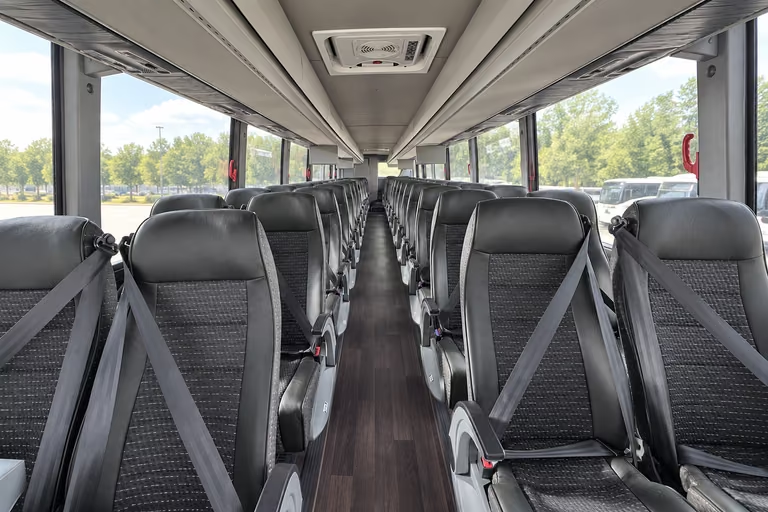
TEMSA offers four motorcoach models in North America, the TS30, the TS35, the TS45, and the all-electric TS45E, as reported by Bus & Motorcoach News. The compact TEMSA TS30 offers the features of a full-size model in a 30-foot body, with dual USB-A and USB-C outlets at every seat. TEMSA calls the TEMSA TS35 the best-selling 35-foot integral motorcoach in North America, and TEMSA's Canadian distributor, Damera, lists seating for 34+1 on the TS30 and 40+1 on the TS35. The full-size TEMSA TS45 seats 56 passengers, and its redesign added a sleek new entrance, ambient lighting, secure parcel racks, and upgraded seating with dual USB-A and USB-C outlets, cup holders, and footrests.
TEMSA Bus Specs
Here's a list of the specifications for the TEMSA TS45, from the TEMSA North America TS45 spec sheet:
| Specification | TEMSA TS45 |
|---|---|
| Gross Vehicle Weight Rating | 51,500 lbs |
| Height | 11 ft 6 in |
| Width | 102 in |
| Length | 45 ft |
| Seats | 56 |
| Underfloor Luggage Space | 460 cu ft |
| Fuel Tank Capacity | 200 gal |
Electric Charter Buses From MCI, Van Hool, Prevost, and TEMSA
Curious whether your next charter bus could be electric? Every manufacturer in this guide has been working on it, but they're at very different stages in 2026.
MCI unveiled the battery-electric J4500 CHARGE touring model and the D45 CRT LE CHARGE for commuter service in 2021, followed by the high-floor D45 CRT CHARGE in 2022. In 2024, MCI shipped its first electric bus out of its Pembina, North Dakota plant.
Van Hool built the CX45E as its first all-electric motorcoach for the U.S. market, and ABC Companies lists the Van Hool CX45E with a 676 kWh battery system. For bigger groups, the TDX25E double-decker carries up to 69 passengers on electric power.
TEMSA built its TEMSA TS45E for North America by combining its electric vehicle technology with the proven characteristics of its TS45, and TEMSA says the batteries leave uninterrupted luggage room underneath the passenger compartment. Prevost is the one to watch: in its 100th anniversary announcement in January 2024, Prevost said its teams planned to introduce a new 100% electric model with a range of 400 km by 2026, while the models on its website today run on the Volvo D13 engine.
Planning a quieter, zero-emission ride for a corporate event or campus shuttle? Mention it when you request your quote, since electric availability depends on the bus companies serving your city.
Does the Charter Bus Manufacturer Matter When You Rent?
It can! The specs above change from model to model, so a 45-foot Prevost H3-45 with 460 cubic feet of underfloor luggage space handles a week's worth of suitcases differently than a 35-foot MCI J3500 with 285 cubic feet. Heading to the airport with a big group? Look for a full-size charter bus with plenty of undercarriage luggage bays, and check out our charter bus packing guide before you go. Want room to stretch out on a long ride? A 45-foot model with 56 standard seats and an onboard restroom is a great place to start, and our complete guide to charter bus amenities shows everything else you can find onboard.
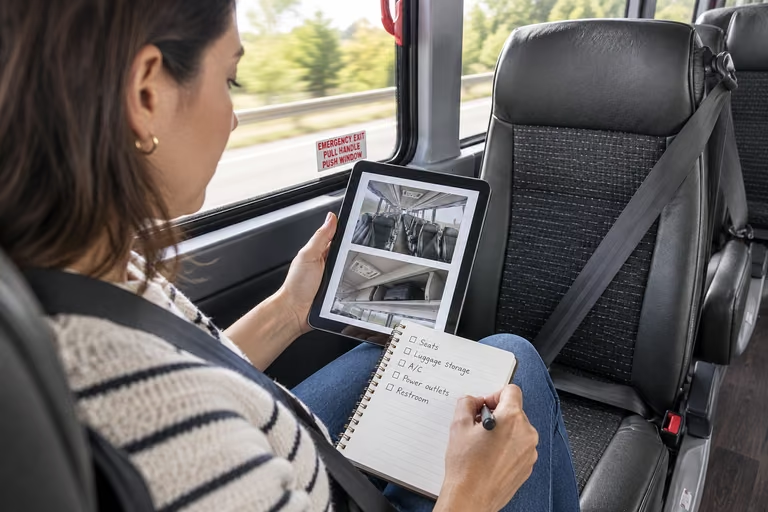
When you use Partybus.com, you can find and book charter buses, minibuses, and party buses from a large network of independent bus companies, see vehicles with photos, and compare bus types and amenities side by side. Wondering what goes into your quote? Our guide to charter bus prices breaks it all down. Have a favorite make or model? Just mention it when you request your quote!
Frequently Asked Questions About Charter Bus Manufacturers
Who builds the best-selling charter bus in North America?
MCI says its J4500 is North America's best-selling touring motorcoach. MCI introduced the J4500 in 2001, it became the industry's best-selling motorcoach by 2004, and MCI celebrated production of its 10,000th J4500 in 2022.
Is Van Hool still making charter buses?
Yes, under new ownership. After Van Hool went bankrupt in 2024, VDL Groep acquired the Van Hool product names and its factory in North Macedonia, and the brand now goes by VDL Van Hool. ABC Companies continues to supply new Van Hool models in the United States and Canada, including the CX35, CX45, CX45E, TDX, and TDX25E.
Which charter bus manufacturers make electric buses?
MCI, Van Hool, and TEMSA all offer battery-electric models in North America. That includes the MCI J4500 CHARGE, the Van Hool CX45E and TDX25E, and the TEMSA TS45E. Prevost announced in January 2024 that it planned to introduce a 100% electric model by 2026.
Which charter bus manufacturers make 35-foot models?
MCI, Van Hool, and TEMSA all build 35-foot charter buses for North America. The MCI J3500 seats up to 44 passengers with a turning radius of under 33 feet, the Van Hool CX35 shares a nearly identical design with the CX45, and TEMSA calls its TS35 the best-selling 35-foot integral motorcoach in North America.
Where are these charter buses built?
It depends on the brand. MCI has fabrication, manufacturing, and service centers in the United States and Canada, including its plant in Pembina, North Dakota. Prevost's manufacturing facility is in Sainte-Claire, Quebec, where the company started, VDL Groep acquired Van Hool's factory in North Macedonia, and TEMSA builds its buses at its 510,000-square-meter facility in Adana, Turkey.
How many passengers fit on a charter bus from these manufacturers?
Most 45-foot models seat 55 to 56 passengers standard. That includes the MCI J4500, Prevost H3-45, Van Hool CX45, and TEMSA TS45 at 56, and the Prevost X3-45 at 55. The MCI J4500 and Van Hool CX45 can be configured for up to 60, the 35-foot MCI J3500 seats up to 44, and the double-decker Van Hool TDX seats 81. Through Partybus.com, you can compare 40- to 56-passenger charter buses, 15- to 35-passenger minibuses, and 15- to 50-passenger party buses from bus companies serving your area. Not sure which size fits your group? Our complete guide to bus types breaks down each one.
Can I request a specific charter bus make or model?
Yes, you can mention a preferred make or model when you request your quote. What's available depends on your city and your date, since every bus comes from an independent transportation provider serving your area. The online search may not include every available vehicle, so call 877-563-2133 if you need something else.
Partybus.com Offers Thousands of Buses Nationwide
Want to rent a charter bus or minibus? Partybus.com can help! Because Partybus.com doesn't own the vehicles, you're never limited to just one fleet! You can find and book party buses, minibuses, and charter buses from a large network of independent bus companies in over 1,000 cities across the United States, with bus pricing in under 30 seconds. You do not need to create an account to view instant online quotes and vehicle pictures.

Whether you're planning Miami charter bus rentals for a cruise transfer, a Chicago party bus for a night out, Atlanta charter bus rentals for a field trip, or a Boston charter bus for an airport run, finding YOUR next bus rental takes just one quick form. Give us a call at 877-563-2133 to speak with a live support team, available every day of the year, and learn more about your bus options!